
What Are the Risks of Not Having a Cybersecurity Plan?

Business Impact
7 Cybersecurity Risks Businesses Should Know

1. Financial Exposure and Recovery Costs
A cyberattack can create costs that continue to affect businesses long after the initial incident. To find the source of the attack and restore operations, businesses may need to pay for investigations, legal support, system restoration and customer notifications while also losing revenue during downtime.
Recent breach and ransomware data show how quickly these costs can add up:
- U.S. data breach costs: The average cost of a data breach in the U.S. reached $10.22 million in 2025, an all-time high.
- Global average: Worldwide, the average breach cost stood at $4.4 million in 2025.
- Ransomware recovery expenses: For businesses dealing with ransomware specifically, the average U.S. recovery cost was $1.91 million, excluding any ransom payment.
- Ransom payments: In the U.S., the median ransom payment reached $1.5 million.
- Small business impact: More than 62% of breached small and midsized businesses (SMBs) reported total financial impact exceeding $250,000.
2. Operational Disruption and Unplanned Downtime
Cyberattacks can quickly turn from a security issue into a business continuity issue. When systems go down or data becomes inaccessible, teams may be unable to serve customers, complete internal work or maintain normal operations. Without a coordinated response plan, downtime can last longer, recovery can move more slowly and productivity losses can grow.
In 2025, organizations took an average of 241 days to identify and contain a cyber breach, resulting in nearly eight months of exposure and response activity. Ransomware recovery timelines vary, but only 53% of ransomware-affected organizations fully recovered within a week.
The impact can also reach the people responsible for response and recovery. In one report, every organization that had data encrypted in a ransomware attack reported direct repercussions for its IT and cybersecurity team, including increased stress, guilt and, in 25% of cases, leadership replacement. The human cost of operating without an incident response plan compounds the technical, operational and financial challenges.
3. Data Vulnerabilities and Information Exposure
Sensitive data is one of the most valuable assets a business holds, and a common target for cybercriminals. Customer records, financial information, employee data and intellectual property all need clear protections. Without a cybersecurity plan, businesses may not have a reliable way to identify where sensitive data lives, who can access it or how it should be protected.
The risks increase when that data is exposed. In 2025, customer personally identifiable information (PII) was the most stolen or compromised data type, appearing in 53% of breaches. Employee PII was stolen or compromised in 37% of incidents, while intellectual property appeared in 33%.
Data risk also extends beyond internal systems. Information held by vendors, partners or service providers may also be vulnerable. A comprehensive data protection strategy should account for both internal and external data flows so critical assets are not left exposed.
4. Reputational Impact and Shifting Customer Confidence
A cyber incident can affect how customers, partners and investors view a business long after systems are restored. If sensitive data is exposed or operations are disrupted, customers may question whether the organization can protect their information and provide reliable service. For businesses in data-sensitive industries like financial services, biotech or professional services, that loss of confidence can be especially difficult to repair.
The market impact can also be measurable. In one analysis, major cyber incidents resulted in an average 9% decrease in shareholder value in the year following the event. Of 1,407 cyber events analyzed, 49 developed into reputation risk events, resulting in a 27% decline in shareholder value.
Certain attack types may create greater reputational risk than others. In the 2025 Hiscox Cyber Readiness Report, malware and ransomware attacks accounted for approximately 60% of reputation risk cyber events, and 29% of SMBs that experienced a cyberattack reported negative publicity as a direct consequence.
5. Legal, Regulatory and Contractual Obligations
Without a cybersecurity plan, businesses may face legal, regulatory and contractual issues at the same time. These risks can be especially serious for organizations in heavily regulated industries like financial services, biotech and life sciences, where data protection is tied directly to compliance and business continuity.
Key areas of exposure include:
- Regulatory fines: Compliance failures related to the General Data Protection Regulation (GDPR), the Health Insurance Portability and Accountability Act (HIPAA) or the Payment Card Industry Data Security Standard (PCI DSS) can trigger substantial penalties after a breach. Europe issued €1.2 billion in GDPR fines in 2024 alone, with cumulative fines since 2018 exceeding €5.88 billion. Noncompliance can also increase breach-related costs on top of fines.
- Civil lawsuits: Individuals whose data is compromised may pursue legal action, including class-action lawsuits that can increase costs and extend the recovery process.
- Government investigations: Regulators may investigate businesses that experience breaches tied to negligence or inadequate safeguards. These investigations can be costly, time-consuming and damaging to customer confidence.
- Contractual breaches: Vendor, partner and client contracts often include data protection requirements. A breach may violate those terms and create additional financial or legal exposure.
- License and certification risk: In regulated sectors, a significant cybersecurity lapse can jeopardize operating licenses or industry certifications required to conduct business.
The financial impact also varies by industry. Healthcare breaches cost an average of $7.42 million per incident. Financial services breaches averaged $5.56 million per incident. For businesses in these sectors, cybersecurity compliance regulations are part of protecting operations, customers and long-term stability.
6. Cyber Insurance Eligibility and Coverage Gaps
Cyber insurance can help businesses recover after an incident, but it does not replace a strong cybersecurity plan. Insurers often want to see that basic protections are already in place before approving or renewing coverage. If those controls are missing or undocumented, a business may have fewer policy options or face complications when filing a claim.
These insurance-related risks are becoming more common:
- Rising claim complications: Cyber insurance claims may be rejected when an incident falls outside the policy's terms, coverage is lower than the total claim or the incident falls below the policy's self-insured retention.
- Required security controls: Insurers often look for safeguards like multi-factor authentication, endpoint detection and response systems, tested backups, and a formal incident response plan.
- Uninsured businesses: 27% of SMBs lack cyber insurance entirely, leaving them to absorb breach-related costs like recovery work, legal support, customer notification and downtime losses on their own.
- Coverage gaps: Having a policy does not always mean a claim will be paid. If the controls listed on the insurance application were not actually in place, the insurer may deny the claim.
7. Evolving Exposure to AI-Powered Threats
AI is changing how cybercriminals plan and carry out attacks. With AI, attackers can create more convincing phishing messages, test new tactics faster, scale campaigns across more targets, and uncover security gaps that may have gone undetected. A cybersecurity plan can help businesses keep pace with these AI-driven risks by updating employee training, response procedures and security tools, including AI-enabled defenses where appropriate.
A cybersecurity plan helps businesses keep pace with those changes. It gives teams a way to update employee training, security policies and response procedures as AI-driven risks evolve. Understanding how AI affects your IT environment can also help your business make smarter decisions about access controls, data protection and long-term security planning.
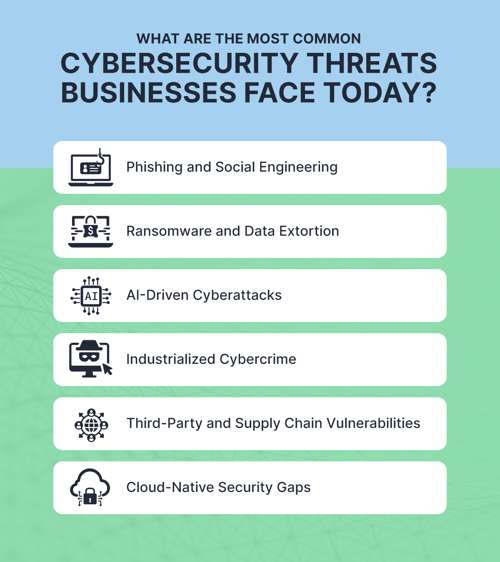
What Are the Most Common Cybersecurity Threats Businesses Face Today?
A strong cybersecurity plan starts with a clear view of how attackers gain access to business systems, data and networks. Today, businesses face several common threats.
Phishing and Social Engineering
Attackers use phishing to send an email, text or message that can trick an employee into sharing credentials, downloading malware or sending money to the wrong account. As AI tools become more common, these messages can also sound more personal and convincing, making them harder to spot.
In 2025, phishing accounted for 16% of all breaches studied, with human involvement as a factor in approximately 60% of cases. AI-generated phishing emails have become more convincing, which makes the risk more difficult to manage. Targets are 4.5 times more likely to click AI-generated phishing emails than traditionally crafted messages.
Reducing phishing risk takes both technology and training. Security awareness programs help employees recognize suspicious messages, report potential threats and avoid actions that can give attackers access to larger systems. Without that support, phishing can become the entry point for a much larger incident.
Ransomware and Data Extortion
Ransomware can stop normal operations by locking teams out of critical systems or data. In many cases, attackers can also steal information and threaten to release it publicly if the business does not pay. This situation creates both an operational crisis and a data exposure risk.
Smaller organizations may have fewer resources to prevent and recover from these attacks. However, paying a ransom does not guarantee a full recovery. Effective incident response planning can reduce the likelihood of a successful ransomware attack and help businesses recover faster if one occurs.
AI-Driven Cyberattacks
AI is giving attackers new ways to make existing cyberthreats more convincing and harder to detect. It can help them write stronger phishing messages, test variations faster, develop more evasive malware and automate attacks across a wider set of targets.
Recent data shows how quickly this risk is growing. AI-enabled cyberattack activity grew by 89% from 2024 to 2025, and some organizations are already seeing breaches tied to AI models or applications. These trends make AI governance an important part of cybersecurity planning.
Many organizations are still catching up. Nearly two-thirds lack AI governance policies, which can leave gaps around access, acceptable use, data protection and response planning. Businesses that work with AI consultants who build secure, scalable AI systems tailored to specific business needs can develop governance frameworks that address AI-related risks before they create larger security issues.
Industrialized Cybercrime
Cybercrime has become more organized and easier to scale. Rather than relying only on one-off attacks, many cybercriminals now use automated tools and repeatable tactics to find vulnerable businesses faster.
This shift challenges the idea that cybercriminals only target one type of organization. Different types of businesses can be attractive targets for different reasons:
- Large organizations often have more data, more connected systems and a larger financial footprint.
- Small and midsized businesses may have leaner IT teams, fewer security tools or less-developed response plans.
- Highly connected businesses can attract attackers because of their relationships with vendors, customers or broader supply chains.
Attackers can use automated tools to scan thousands of potential targets at once, so risk is not limited to one industry or company size. An unpatched system, weak access controls or exposed data can be enough to put a business in their path.
Third-Party and Supply Chain Vulnerabilities
A business's cybersecurity also depends on the vendors, partners and software providers it works with. Even if internal systems are well protected, a third party with weak security practices can create an opening for attackers. This risk is especially important for regulated businesses that share sensitive data with outside organizations. These incidents can also take longer to resolve because the affected systems, data and responsibilities may span multiple organizations.
A strong cybersecurity plan should include vendor qualification and ongoing management to ensure external partners meet security expectations and do not weaken the business's overall security.
Cloud-Native Security Gaps
Cloud adoption can help businesses move faster, but it can also make security harder to manage. Data may live across public cloud, private cloud and on-premises systems, while employees may also use outside AI tools as part of their daily work.
Without clear oversight, it becomes harder to know where sensitive information is stored, who can access it and which settings may create risk. That visibility gap can slow response after a cyberattack. In 2025, 30% of breaches involved data distributed across multiple environments.
Clear policies for cloud services, AI platforms and access controls help reduce those risks before they turn into data exposure.
.png?width=2000&name=New%20Website%20images(1).png "New Website images(1)")







.png)
.png)